Showing posts with label Revell. Show all posts

Thursday, April 7, 2011

‘Coach Wooden: The 7 Principles That Shaped His Life and Will Change Yours’ by Pat Williams and Jim Denney – Book Review

Buzz this
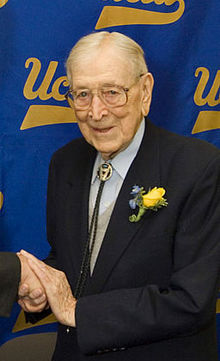
I am a pretty big sports fan. One of the legends in that realm is Coach John Wooden, legendary coach of the UCLA basketball teams from 1948 to 1975 (he passed away on June 4, 2010 at age 99). Pat Williams and Jim Denney have written a new book entitled ‘Coach Wooden: The 7 Principles That Shaped His Life and Will Change Yours.’

Here is a synopsis of this inspirational book:


Legends aren’t born. They’re made. When John Wooden graduated from eight grade, his father gave him a handwritten card and said, “Son, try to live up to this.” On the card, his father had written seven simple yet profound life principles:

Be true to yourself


Help others


Make friendship a fine art


Drink deeply from good books, especially the Bible


Make every day your masterpiece


Build a shelter against a rainy day by the life you live


Give thanks for your blessings and pray for guidance every day


These principles were the key to Coach Wooden’s greatness – and his goodness. Through powerful stories and advice, this book shares the wisdom that made Wooden happy and successful, not just in his career but in his life. This inspiration and conversational book will encourage, challenge, and motivate you to build these principles into your own life so that you can impact the lives of others.


Here are the biographies of the authors:


Pat Williams is senior vice president of the NBA’s Orlando Magic. He has almost fifty years of professional sports experience, has written seventy books, and is one of America’s most sought-after motivational speakers. He lives in Winter Park, Florida.
Jim Denney is a writer with more than eighty published books to his credit. His collaborative titles include Reggie White in the Trenches: The Autobiography, with the Super Bowl champion; Undefeated, with father-son Super Bowl/Rose Bowl champs Bob and Brian Griese; A Model for a Better Future with Kim Alexis and numerous books with Pat Williams, including Go For the Magic.


I had the great good fortune to read another title by Pat Williams (co-written with his wife, Ruth) – ‘Happy Spouse Happy House: The BEST Game Plan for a Winning Marriage’ (you can read my review – one of my first - here).


Here is a clip of Mr. William in the Green Room at the ‘700 Club.’ He correctly predicted the winner of this year’s NCAA Basketball tournament; he also gave some wise advise to Tiger Woods:


Here is a video of Coach Wooden from 2001 as posted by TED
(a remarkable organization; I encourage you to check it out!). It’s lengthy, but well worth your time:


Coach Wooden was profoundly and positively influenced by his father, Joshua Wooden:


Joshua Wooden used those tough times to impress life lessons on his four sons. “Blaming, cursing, hating doesn’t help you,” he told them. “It hurts you.” It was also during this time that he taught his four sons what he called “the two sets of threes”: “Never lie, never cheat, never steal,” and, “Don’t whine, don’t complain, don’t make excuses.” (p. 33)


One of the seven life principles that Coach Wooden was taught by his father is ‘Be True to Yourself’:

What does it mean to be true to yourself? This is not a command to be selfish or self-absorbed. It’s a command to be faithful to your highest self, to your values, your honor, your integrity, the reputation you wish to maintain. Be faithful to your commitment to be a person of character, courage, commitment, devotion, perseverance, and diligence. Refuse to compromise yourself. Never sacrifice your principles. Refuse to betray your values. If you remain true to the best that is within you, you will never be false or disloyal to any other person. (p. 45)

Coach Wooden’s faith was strong. His life reflected his love of the Lord:

Fred Hessler, UCLA radio announcer, said, “John Wooden tried harder than any man I have ever met to be like Jesus Christ.” And Los Angeles sportswriter Bud Furillo observed, “John Wooden proves that Christian ideals must work. They do in his life.” And longtime UCLA golf coach Eddie Merrins said, “Coach doesn’t wear his faith on his sleeve, but everything he does in life is designed to please God.” (p. 160)


This book includes two appendices. The first one details Coach Wooden’s Legendary Record; it is truly remarkable, and unmatched by any coach in any sport. In fact, on July 29, 2009, the Sporting News named Coach Wooden the Greatest Coach of All Time in any sport, college or professional. Appendix 2 highlighted ‘Woodenisms,’ words of wisdom (most Biblically based) that he shared with people throughout his long and distinguished life. Here are a few:


ACCOMPLISHMENT (ACHIEVEMENT)


Don’t measure yourself by what you have accomplished but by what you should have accomplished with your ability. (p. 177)


ATTITUDE


Things turn out best for the people who make the best of the way things turn out. (p. 178)


Coach Wooden left a remarkable legacy! And this is a wonderful book! My husband, Fred, has been an admirer of Coach Wooden for many years; I will be passing this book along to him to read. This hardcover would make a terrific book for a high school or university graduate (of either gender!); it would also make a great Father’s Day gift for the fathers and husbands in your lives. I plan on making some changes in my life to exemplify the life of a man who impacted a multitude of people to live better lives.

You can order this book here.


Available February 2011 at your favorite bookseller from Revell, a division of Baker Publishing Group. This book was published by Revell and provided by them for review purposes.

Wednesday, September 15, 2010

The Winner of Suzanne Woods Fisher's 'Amish Proverbs' is.....

Buzz this
The Random Number Generator has been a trooper again, and has chosen another winner - this time, for 'Amish Proverbs: Words of Wisdom from the Simple Life,' the awesomely beautiful and wise book from Suzanne Woods Fisher.


Without further ado, the winner is......


Bakersdozen!


Congratulations - I will be contacting you via email for your mailing address!


For those of you who did not win this gorgeous gift book, you can order it here. It makes a terrific gift (Christmas will be here before we know it!).


Thanks to everyone for entering. And please come back soon, as there will be more blog posts and giveaways to come!


And thanks again to Revell for providing this book for giveaway purposes. 

Tuesday, August 31, 2010

‘Amish Proverbs: Words of Wisdom from the Simple Life’ by Suzanne Woods Fisher – Book Review and Giveaway

Buzz this


The Amish community has been an interest/passion of mine since I visited the Lancaster, Pennsylvania area as a young person. So when I am near an Amish community or have the opportunity to learn more about them, I take advantage! One of my favorite new authors, Suzanne Woods Fisher, has just released a beautiful new book, ‘Amish Proverbs: Words of Wisdom from the Simple Life.’ Favorite author + Amish community = I’m there!

Here’s a synopsis of this lovely book:

          Simplify your life with Amish wisdom.
Through firsthand research and personal relationships, Suzanne Woods Fisher has collected more than 200 proverbs that cover the rich heritage, folklore, faith, values, history, and essence of the Plain People. These proverbs serve as teaching tools and maxims for practical living – but they’re not just for the Amish. They’re for anyone who seeks God’s wisdom and truth for everyday circumstances.
Ranging from the simple to the profound, from the serious to the humorous, these sayings will stick with you through life’s joys and sorrows. With beautiful full-color photos throughout, Amish Proverbs is the perfect gift for any occasion.

Here is the biography of the author:

Suzanne Woods Fisher first became interested in the culture of the Plain People through her grandfather, W.D. Benedict, who was raised in the Old Order German Baptist Brethren Church in Franklin County, Pennsylvania. She had a warm relationship with her Dunkard cousins and asks them many questions, which they patiently answer.
Fisher is the author of Amish Peace: Simple Wisdom for a Complicated World and the bestselling novel, The Choice, the first in her Lancaster County Secrets series. Her work has appeared in many magazines, including Today’s Christian Woman, Worldwide Challenge, ParentLife, Christian Parenting Today, Marriage Partnership, and many others. Suzanne  lives with her family in the San Francisco Bay area. She loves to hear from her readers.

In the Introduction, Suzanne explains that we all need wisdom:

These sayings and proverbs, dear to the Amish, can help the English (non-Amish) better understand them. For example, here are two proverbs that reveal how the Amish value the virtue of patience: “Only when a squirrel buries and forgets an acorn, can a new oak tree come forth,” and “Adopt the pace of nature; her secret is patience.”
Proverbs are just as useful in our life today as they are to Old Order Amish families. They’re just as relevant to us as they were to the Israelites in King Solomon’s day. They help point us toward wisdom, toward good judgment, towards God’s teachings. To please God, we must know what he values; what does he care about? What does he love? What does he hate? Proverbs teach us about God. (p. 13)

This book is divided into several categories: Time, Money, Faith, Children & Family, In Word & Deed, Work Ethic, Handling Adversity, Education, Community, Character and Just for Fun.

Here are a few from the Faith section:

·         Bibles that are coming apart usually belong to people who are not.
·         It may be difficult to wait on the Lord, but it is worse to wish you had.
·         He who bows lowest in the presence of God stands straightest in the presence of sin. (p. 47)

And here are a few from the ‘In Word & Deed’ section:

·         All that you do, do with your might. Things done by halves are never done right.
·         Swallowing words before you say them is so much better than having to eat them afterward.
·         When you speak, always remember that God is one of your listeners. (p. 86)

And these are from the Community chapter:

·         It’s nice to be important, but it’s more important to be nice.
·         Swallowing pride rarely gives you indigestion.
·         Many things have been opened by mistake, but none so frequently as the mouth. (p. 180)

And, finally, from the Just for Fun chapter:

·         Every family tree has a little sap.
·         Age is a question of mind over matter. If you don’t mind, it doesn’t matter.
·         Those who have no children know best how to raise them. (p. 197)

This is the second book from Suzanne that I have read; the first was ‘The Choice,’ Book One in her Lancaster County Secrets series (you can read my review here). Book Two in the Lancaster County Secrets series is ‘The Waiting;’ I am waiting until it releases on October 1, 2010!

I appreciated the fact that Suzanne and the publisher honored the wishes of the Amish, who do not believe in having their faces photographed. There are many photos in this book, but they all show the Amish from the side or back views.

I highly recommend this book. It is full of wisdom, and so beautifully written and designed! It would be perfect for a gift for anyone for any occasion – everyone needs more wisdom!

You can order this book here.

This book was published by Revell Publishers and provided by them for review and giveaway purposes.
_______________________________________________

I have a copy of this absolutely beautiful book that I would love to send along to one winner! 

There are several ways to gain entry:

1) Leave a comment here on the blog, sharing with us a proverb that has reverberated in your family. Please make sure to leave your email address in this format – sample[at]gmail[dot]com.

2) Follow me on Twitter; I will more than likely follow you back!  If you are already a Twitter follower, that counts, too!  Please leave a new comment to that effect.

3) Follow me as a Google Friend on this blog; if you are already a Friend, that counts, too!  Please leave a new comment to that effect.

4) Become my Facebook friend.  Please leave a new comment to that effect.

5) Follow this blog as a NetWorked Blog Follower after you’ve become my Facebook friend.  Please leave a new comment to that effect.

So there are five chances to enter!  Please limit one entry per option.

This giveaway is for U.S. residents only.  The deadline for entry is Tuesday, September 14, 2010 at 11:59 p.m. EST.  A winner will be chosen via the Random Number Generator on Wednesday, September 15, 2010 and will be contacted via email.  The best to all of you!


Friday, August 13, 2010

‘The Seeker’ by Ann H. Gabhart – Book Review

Buzz this


I have long been interested in the ‘simple’ life and those who live that life, including the Shakers and the Amish. ‘The Seeker’ by Ann H. Gabhart is set in a Shaker community in Kentucky during the U.S. Civil War.

Here is the synopsis of this book:

Charlotte Vance is a young woman who knows what she wants. But when the man she planned to marry joins the Shakers – a religious group that does not allow marriage – she is left dumbfounded. And when her father brings home a new wife who is young enough to be Charlotte’s sister, it is more than she can bear. With the country – and her own household – on the brink of civil war, this pampered gentlewoman hatches a plan to avoid her new stepmother and win back her man by joining the Shaker community at Harmony Hill. Little does she know that this decision will lead her down a road of unforeseen consequences.
Ann H. Gabhart brings alive the strikingly different worlds of the Southern gentry, the simple Shakers, and the ravages of war in 1860s Kentucky to weave a touching story of love, freedom, and forgiveness.

Here is the biography of the author:

Ann H. Gabhart and her husband live on a farm just over the hill from where she grew up in central Kentucky. They live just thirty miles from a restored Shaker village in Kentucky. Ann  has walked the same paths that her characters might have walked in generations past. She’s active in her country church, and her husband sings bass in a Southern Gospel quartet. Her first inspirational novel, The Scent of Lilacs, was one of Booklist’s top ten inspirational novel of 2006. Gabhart is the author of several books, including the bestselling The Outsider, a finalist for the 2009 Christian Book Awards in the fiction category, and The Believer.

Here is a video of the Shaker standard tune called ‘Simple Gifts,’ one of my favorite songs, as performed by Alison Krauss (one of my favorite musicians) and Yo-Yo Ma. Please be prepared for some goose bumps!:


Ann shares some information in ‘A Note About the Shakers:’

American Shakerism originated in England in the eighteenth century. Its leader, a charismatic woman named Ann Lee, was believed by followers to be the second coming of Christ in female form. After being persecuted for those beliefs in England, she and a small band of followers came to America in 1774 to settle in Watervliet, New York, and there established the first community of the United Society of Believers in Christ’s Second Appearing, more commonly known as Shakers.
When religious fervor swept the Western frontier at the turn of the nineteenth century, the Shakers, whose communities in New England were flourishing, found the spiritual atmosphere in Kentucky perfect for expanding their religion to the west. By the middle of the nineteenth century the Shakers had nineteen communities spread through the New England states and Kentucky, Ohio, and Indiana.
The Shaker doctrines of celibacy, communal living, and the belief that perfection could be attained in this life were all based on revelations that Mother Ann claimed to have divinely received. The name Shakers came from the way they worshiped. At times when a member received the “spirit,” he or she would begin shaking all over. These sorts of “gifts of the spirit,” along with other spiritual manifestations such as visions, were considered by the Shakers to be confirmation of the same direct communication with God they believed their Mother Ann had experienced.…
In Kentucky, the Shaker villages of Pleasant Hill and South Union have been restored and attract many visitors curious about the Shaker lifestyle. These historical sites provide a unique look at the austere beauty of the Shakers’ craftsmanship. The sect’s songs and strange worship echo in the impressive architecture of their buildings. Visitors also learn about the Shakers’ innovative ideas in agriculture and industry that improved life not only in their own communities but also in the “world” they were so determined to shut away. (pp. 7-8)  

One of the things that brings fame to the Shakers are their staircases, which seem to defy the laws of gravity.

Charlotte’s life was in a state of upheaval at the beginning of the book – her betrothed decided to join the Shakers, who prohibit marriage, and her father came home with a new wife, Selena, who was only a few years older than her.

A new acquaintance who was a little more positive for Charlotte was Adam Wade, an artist who was going to paint a portrait of the new Mrs. Hunt:

“Oh no. I fear I am just a hired artisan.” The man laughed out loud and bowed at the waist toward Charlotte. “Adam Wade at your service, Miss Vance.”
“And for what purpose have you been hired, if I may be so bold to ask? A cupola here in my mother’s garden?”
“Perhaps artisan is not the proper word. Artist. Although my grandfather’s practical side shudders every time I claim the title. But that is what I am. An artist. A curse I fear I was born with. And I have been commissioned – or a better word might be coerced – to paint a wedding portrait of the lovely Mrs. Vance.”
“Coerced? By whom? Our Selena?” She carefully emphasized the last two words.
“Oh, no.” He laughed again. Easily, without inhibition. “I barely know the woman.”
“Neither does my father.”
“You have a point, but not one, I am relieved to say, that can poke me. My sister, Phoebe, knew our Selena back home in Boston, and she is the one whose coercion I cannot ignore. Not and maintain any sort of familial peace.” (p. 21)

In addition to his portrait work, he knew he could get some other work done:

Adam rubbed his fingertips and thumb together in anticipation at the thought of the Shakers. Their village just a few miles from where he stood in the senator’s garden – another reason he was not sorry to be in Mercer County. Sam Johnson, the editor at Harper’s Weekly, was eager to see sketches of their buildings and the graceful winding staircases that so amazed all visitors.
While Adam was ready to supply whatever illustrations the editor requested, he was more curious about the particular people who would choose such a life. Men and women who had turned against all that was  natural between a man and woman as if they believed the Lord had changed his mind about his initial command to Adam and Eve to be fruitful and multiply. (p. 33)

Another important theme in this book is the practice of slavery:

The word slave never crossed her mother’s lips. Those who did her bidding and kept Grayson running were their people. But Charlotte knew the word from her father and from Aunt Tish [one of their slaves] and from Willis, the gentle black man who brought her pony out to her and taught her how to ride. Still, she was going on ten before she understood, really understood, what being a slave meant. (p. 39)

Adam was given the opportunity to visit the Shaker community. He was taken aback by what he saw:

Adam glanced up at the sun straight over his head. The bell had evidently summoned them to their midday meal. He slid off his horse and held the reins while he pulled out his sketchpad. They were all as alike as ants trailing into an anthill as they filed past him. The women wore white caps and large white collars lapping over their bosoms to tuck down in their aprons, covering their plain dresses. The men wore straw hats with wide brims and suspenders to hold their butternut brown or gray pants. (p. 63)

Sister Martha, one of the Shakers, became very attached to Sister Charlotte. She explained some of their practices and beliefs to Charlotte:

          “Is that what they’re doing? Dancing down glory?” Charlotte asked.
“I suppose that sounds strange to you,” Sister Martha answered with a gentle smile. “Never fear, you will learn your ways. But first you must free yourselves from thoughts of the world. Whatever worries you had there are no longer important. You have left that life for a better life here with us where there is only peace and harmony.”
Peace and harmony. Charlotte wondered if such was even possible with the nation split and shots fired at Fort Sumter. The news received at the Shaker village since then didn’t hold out much hope for peace with the threats of blockades of the Southern ports and the call to arms by both sides. The situation seemed to be totally out of control. The same as Charlotte’s life.
A few days ago it seemed reasonable to follow Edwin to the Shaker village to convince him he was wrong to be a Shaker. A few days ago she had believed she would be able to hang on to Grayson. To go home again and sit in the peace of Aunt Tish’s kitchen. Her kitchen.
But now she was sitting in a church without an altar, watching men and women whirl until they collapsed from the effort, eating imaginary fruit while people watched from peepholes to be sure she was obedient. Reason was lost. (pp. 163-164)

I was interested in Adam’s interpretation of the Shakers’ lifestyle to stay separated from the world:

It seemed a strange life. Everything so ordered and serene. Elder Logan claimed all strife had been removed for those who dwelt there, but how could one live in a tranquil sea day in and day out? A man needed the water of his life stirred by breezes. Else he stayed in the doldrums and wasted away for lack of challenge. And yet here were all of these men and women seeking those doldrums. It was more than Adam could understand. And certainly nothing he could ever want. (p. 216)

Being that this story is set in 1861 and 1862, during the U.S. Civic War, there are a lot of war scenes. Truth be told, I am not necessarily interested in war scenes, and was more interested in the Shaker lifestyle scenes.

I was a little saddened by how dour the Shakers’ world was:

When Dulcie noticed her lifting a pink rose close to her face to catch its sweet fragrance, she warned her. “We are not to smell the roses, Sister Charlotte. It slows the progress of filling our baskets.”
“But the fragrance brings peace to my spirit, and aren’t we all to seek such peace?”
“Sister Altha would tell you such peace is found through prayer and laboring of our songs in meeting. Not in shirking the proper performance of your duties.” (p. 257)

It was interesting that both Charlotte and Adam became closer to the Lord, even amidst people who have an incorrect and non-biblical worldview. It proves that the Lord can reach people in many diverse ways.

Ann has increased my interest in the Shaker lifestyle. There are lots of places in Kentucky I want to visit, and Pleasant Hill, which is only about a six hour drive from our Metro Detroit home, is one of them. I thank Ann for increasing my awareness of this interesting sect in this book.

You can order this book here.

Available July 2010 at your favorite bookseller from Revell, a division of Baker Publishing Group.  This book was provided by Revell for review purposes.

Thursday, August 5, 2010

‘The Bishop: A Patrick Bowers Thriller’ by Steven James – Book Review

Buzz this

There is nothing better than a thrilling page-turner! I have found just such a book in the latest book by Steven James, ‘The Bishop.’

Here is the synopsis of this suspenseful novel:

          The Game Is On.
FBI Special Agent Patrick Bowers’s cutting-edge skills are about to be pushed to the limit when a young woman is found brutally murdered in Washington DC. Her killers continue a spree of perfect crimes in the Northeast, but with nothing to link them to each other, Agent Bowers faces his most difficult case yet – even as his personal life begins to crumble around him.
The Bishop is a gripping adrenaline-laced story for readers who are tired of timid thrillers. Strap on your seat belt and get ready for a wild ride.

Here is the biography of this author:

Critically acclaimed author Steven James has written more than twenty books, including the bestselling thriller series THE BOWERS FILES. One of the nation’s most innovative storytellers, Steven developed his skills as a performer at Eastern Tennessee State University (MA in storytelling). James is a popular conference speaker and has taught writing and storytelling throughout North America, as well as in India, Kazakhstan, and South Africa. He lives in Tennessee with his wife and three daughters.

I was drawn to the main character, FBI detective Patrick Bowers, from page one. Although this is not the typical ‘Christian’ book, there were definitely spiritual elements to it, and there were characters who were Christ followers, including Denver Detective Cheyenne Warren, who was working on the latest case with Detective Warren.

The two main protagonists, Astrid and Brad, were also compelling – but they were 180 degrees away from Dr. Bowers. They were the personification of evil.

Patrick had suffered a tragedy in his life in the past year. The sections of the book featuring Patrick are written in the first person:

Christie and I had met in the spring, married in the fall, and only nine weeks after the wedding, she found the lump in her breast. She passed away before the one year anniversary of the day we met.
Tessa [Christie’s 17 year old daughter] had grown up without ever meeting her father, and, regrettably, things had been strained between us from the start. Then after Christie died, it only got worse.
In time, though, Tessa and I started to feel comfortable around each other, even close – until a few weeks ago when she stumbled across her mother’s diary and discovered that her biological father was alive and well and living off the grid in the mountains of Wyoming.
Her real father. (p. 28)

Mr. James obviously has done a great deal of research in the criminal justice system in the United States; his attention to detail is exemplary. Here is the description of how things are structured:

American law enforcement is set up like a plate of spaghetti, and the individual noodles overlap, wind together, and get entangled all the time. Depending on the type of crime and where it’s committed, you might have eight or nine state and federal law enforcement entities, intelligence agencies, military units, defense organizations, and justice department agencies all trying to investigate it.
And most likely not sharing information all that efficiently as they do.
Each of the armed forces has their own division of criminal forensic investigators; add in a helping of the ATF, DEA, CIA, FBI, NSA, and Federal Marshals, the Secret Service, US Customs and Border Protection, the Bureau of Diplomatic Security, even the Office of Inspector General for the United States Postal Service – as well as regional and state law enforcement, sheriff’s departments, and the six classified investigative agencies that don’t appear on any government books—
It’s mind-boggling. (p. 52)

Detective Bowers, as seems to be the case with the majority of law enforcement officials, has some cynicism when it comes to the subject of death:

A moment of tranquility, of grace, overcome by fear. The jittery race for survival. Like running from death.
          Always running.
          Always being chased.
          I looked at the pictures again.
          A race we all lose.
          Like Calvin did.
          Like Mollie Fischer.
          Like so many victims I’ve seen over the years.
          Their dead, staring eyes. Their quiet, gray lips.
          And their shattered, grieving families. (p. 90)

Patrick’s stepdaughter Tessa is also extremely intelligent, and is able, at age 17, to hold her own against her PhD degreed stepfather. Here’s an exchange regarding evil, beginning with Patrick:

“I guess I think of it more like we’re all born with a shell of good around us, but it’s fractured – for everyone it is. We all know what’s right – even psychopaths who lack empathy are aware of their lack of compassion. I think all people know what’s good, even though, all too often, we’re attracted to what is not.”
“To the fractures.”
“Yes.”
She thought for a moment. “Are you saying we have an instinct for evil?”
“I wouldn’t put it that way. But we definitely have a weakness for it. I guess I’d maybe even say an inclination toward it.”
She peered at the forest. “Because sometimes we enjoy doing it.”
“Yes.” It was troubling to admit. “Sometimes we do.”
“And if we’re good, then we seal up the fractures? Is that what you’re saying?”
This is where things got a little sticky. “Actually, I don’t think we can seal them, Tessa. I don’t think anyone ever has. That’s why we have to be aware of --”
“Dr. Werjonic.”
“What?”
“What he said: ‘The road to the unthinkable is not paved by slight departures from your heart, but by tentative forays into it.” (p. 322)

I also loved this exchange between Patrick, Tessa, Detective Cheyenne Warren, and Lien-hua, an FBI detective on Patrick’s team (who, along with Cheyenne, had had a brief romance with him). Patrick opens very carefully the subject of differences between men and women:

“I’m just saying—“ By the looks on their faces I decided I’d better try a different tack. “However, you do know that some feminists might argue that masculine and feminine roles are simply social constructs and not physiological traits.”
“Then they’re ignoring the research.” Cheyenne shook her head. “But that’s no surprise. In one of the tragic ironies of the twentieth century, feminists never fought for women to become more feminine.”
“What do you mean?”
“Instead of celebrating what it means to be a woman, to be feminine, to be an empowered female, they fought for women to act and be treated more like men. That’s why I call them masculinists.”
“You call feminists masculinists?” I said.
“That’s right.”
She must have noticed the surprise on all of our faces because she went on to elaborate. “Yes. Masculinists. Because in their fight for more rights, they ended up devaluing what it means to be a woman and emulating the very things they criticized most in men – imperialism, identity confusion, militaristic propagandism, dehumanizing competition, careerism.”
Lien-hua, Tessa, and I glanced at each other. I had the sense that all of us were unsure what to say.
Cheyenne set down her chopsticks. “Women should be extended the same dignity, opportunity, and respect as men but shouldn’t be treated in an identical way; equality without uniformity. I want to be treated like a woman, not a pale imitation of a man.”
“You go, girl,” Tessa said.
Cheyenne took her up on the offer. “Women should never be ashamed to be feminine. Strength comes from conviction, not from acting like a man. Being feminine doesn’t mean I’m weak, it just means you’re proud to be a woman.” (p. 331)

Mr. James used Cheyenne’s character to speak the truth of Scripture on a regular basis. Here’s an exchange between her and Lien-hua, with Lien-hua describing to Cheyenne and Patrick a dangerous situation in which she found herself:

“Well, I was terrified, of course, and when the water was going over the head, I…” Lien-hua hesitated, and I think we could all tell how difficult it was for her to share her story. “Being raised in a Buddhist home, I wasn’t even sure if God existed, but I prayed, and someone arrived just in time to save me.” Her eyes found mine just as Cheyenne’s had a minute ago. “I’m still trying to sort out what all that means.”
          “It means,” Cheyenne said, “that God still has big plans for you.”
          “I hope you’re right.” (p. 335)

Tessa helped Patrick in some research on his case, dealing with evolution and natural selection, and she wrestled with some of her findings:

Through the years, evolutionist thinkers like Hobbes, Huxley, Freud, who all held unflinchingly to natural selection, had inexplicably encouraged people to rise above their natural instincts, a view shared by atheist proselytizer Richard Dawkins: “In our political and social life we are entitled to throw out Darwinism, to say we don’t want to live in a Darwinian world.”
Okay, but how, if we’re the result of genes, can we “throw out” being the result of our genes?
Talk about being illogical.
You can’t have it both ways – either we’re determined to be as we are by natural selection, or we’re not. And only if we’re not can we act in ways that are contrary to instinct. An animal constrained by instinct can’t suddenly decide to become something that instinct doesn’t allow it to be.
So, if natural selection really was natural and not somehow guided by God, the entire spectrum of human behavior would be natural. Instinctual. The good stuff and the bad stuff. All just part of being a highly evolved primate.
A species being true to itself.
People being true to their hearts.
To the fractures.
And the whole idea of “man’s inhumanity to man” would be a logical contradiction, because it would be impossible for a human to act in a nonhuman, or inhuman, way.
Chilling. (p. 405)

Another deep subject addressed in ‘The Bishop’ is transhumanism, a subject with which I was, for the most part, unfamiliar. Nor was Margaret Wellington, the FI Executive Assistant Director:

Margaret wasn’t familiar with transhumanism, but it didn’t take her long online to discover that it was controversial since much of it involved not just augmentation but species advancement – through neuro-implants and gene therapy – creating humans with better eyesight, strength, or mental capabilities than the human race had ever developed on its own.
Through genetic manipulation, scientists would soon be able to give people the reflexes of a panther or the strength of a gorilla or the eyesight of a falcon. And by implanting chips into their brains, provide them the ability to remember nearly everything they learned or experienced. Because of transhumanism’s ultimate goal of improving the human race, transforming it even, into a superior species altogether, some people were calling it twenty-first-century eugenics.
Neuroscience. Nanotechnology.
Metacognition. (p. 413)

Cheyenne shared her faith one more time when she and Tessa were engaged in one of their favorite activities – a game of chess:

Tessa set the bishop on the black square beside her queen…. Tessa asked, “Did you ever meet one? I mean a person who never changed colors at all? Who had no duality?”
Detective Warren reflected on the question for a moment. “Just one.”
Tessa figured she was talking about the killer in Denver, Giovanni, who’s been the reason EAD Wellington had allowed her into the National Academy program – to help give her some distance from Denver, from the case. “Giovanni?” Tessa said.
But Cheyenne shook her head. “No. A carpenter. From Nazareth.” Considering the detective’s faith, the answer didn’t really surprise Tessa. She was quiet. “Yeah,” she said at last. My mom met him too. Before she died.” (p. 517)

This book ended with a cliffhanger. We will have to wait to see what happens next in Book Five in the Patrick Bowers Thriller series.

Being that this is a crime thriller, it is expected that there will be some blood and gore. There is some of that, but it could certainly have been more graphic. Being that it is published by Revell, a Christian publisher, I assume the violence was toned down; but be aware that are some excruciating details in these 520 pages.

It has been a while since I have read a book in this particular genre (crime/suspense).  Life does not necessarily allow one to read a book in one sitting (especially one that is over 500 pages), but if I were able to, I would have read this book from start to finish without any break. I wanted to know what was going to happen next – the book continually drew me back. And, to me, that is the sign of a compelling book and a talented writer. This book is intelligently written – Mr. James makes you think, and that’s a good thing! And I love reading books where I am exposed to new ideas; ‘The Bishop’ is chock full of them – whether we like some of them or not.

This is the first book I have read from Mr. James’ computer – but not my first encounter with him. I met him back in 2005 when he was brought in to the church I attended at the time – to teach children’s ministry leaders! He is also the author of several children’s books. When I realized that this Steven James is the same Steven James, I was surprised! This book is not for children!

This is the fourth Bower Files novel from Mr. James – the other three are ‘The Pawn,’ ‘The Rook’ and ‘The Knight.’ Can you detect a trend here?! The next book will be called ‘The Queen’ and will release in Summer 2011. With this theme in place, I think it is safe to assume that there will be at least two more books featuring Detective Bowers. Although this book stands alone, I am interested in reading the other books in the series. And I wouldn’t mind seeing these books makes into movies; they’re perfect for the big screen!

You can order this book here.

Available August 2010 at your favorite bookseller from Revell, a division of Baker Publishing Group.  This book was provided by Revell for review purposes.

 
Clicky Web Analytics